

3 Home Remedies for Substack Writer’s Block
The Substack Writer at Work Series

» In 2026, I’ll be giving paid subscribers and Premier members a taste of the writing guidance I use with my students at Northwestern and my Craft of Writing on Substack course. Upgrade for access all year long:
Emotionally speaking, the stakes are relatively high on Substack.
Posting means you’re writing publicly and getting an immediate response. That’s a beautiful thing: Substack has gifted us direct access to an audience of readers.
But it’s not normal. Writers used to be alone in a room. We wrote at our desks, emailed back and forth with our editor, bought the Times or whatever publication when it came out, and that was it. We had no idea if anyone liked it.
On Substack, it’s all vulnerability all the time.
And when the likes are few and the comments nonexistent or not enough, enter writer’s block—or at least the risk of it.
Substack writer’s block looks like not posting—or posting lifelessly. Or giving up entirely. There are a lot of dead Substacks:
Many as a result of “writer’s block.”
The ailment
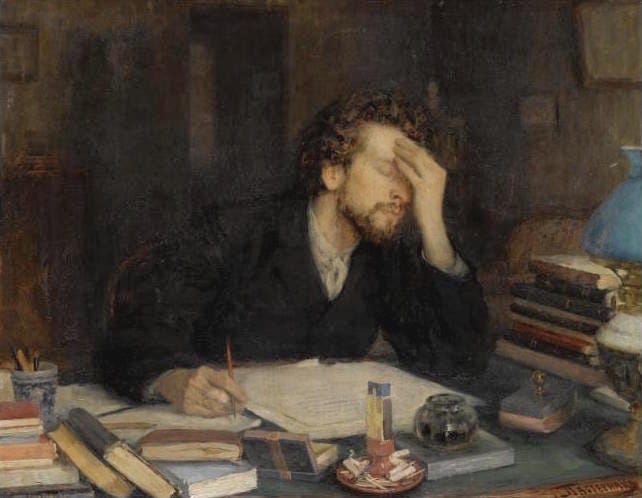
Writer’s block is generally viewed as a condition, practically an ailment. Leonid Pasternak’s The Passion of Creation (see above) comes up in almost every Google search of the phrase. The painting depicts writing as high drama and writer’s block as total despair. (Leonid was friends with Leo Tolstoy, who had a way of creating serious drama in his life. He was a serious philanderer, made his wife, Sophia, practically a slave to him, and then left her at the age of 82, and started what was basically a cult that got him excommunicated from the Russian Orthodox Church.)
On Substack, the experience of what’s called writer’s block is real. We avoid, suffer, and succumb to a fervent unenthusiasm for whatever post we’re writing or going to write. My clients describe it as being “stuck,” “frozen,” “flailing,” or “overwhelmed.”
But Substack writer’s block is just impatience and an unwillingness to be in the muck.
The cure
Writing is a process. “Everyone” says it, and “everyone” is right.
I take my Craft of Writing students through five stages. Obviously, I’m not the first person to write about these five stages, but I look at them differently than most writers do: 1) idea building, 2) the Zero Draft, 3) revising for content, 4) editing for style, and 5) proofreading.
Writer’s block only occurs when you try to skip a step—or all the steps—and go from a nascent idea to a final, stunning, subscriber-generating final post like this:
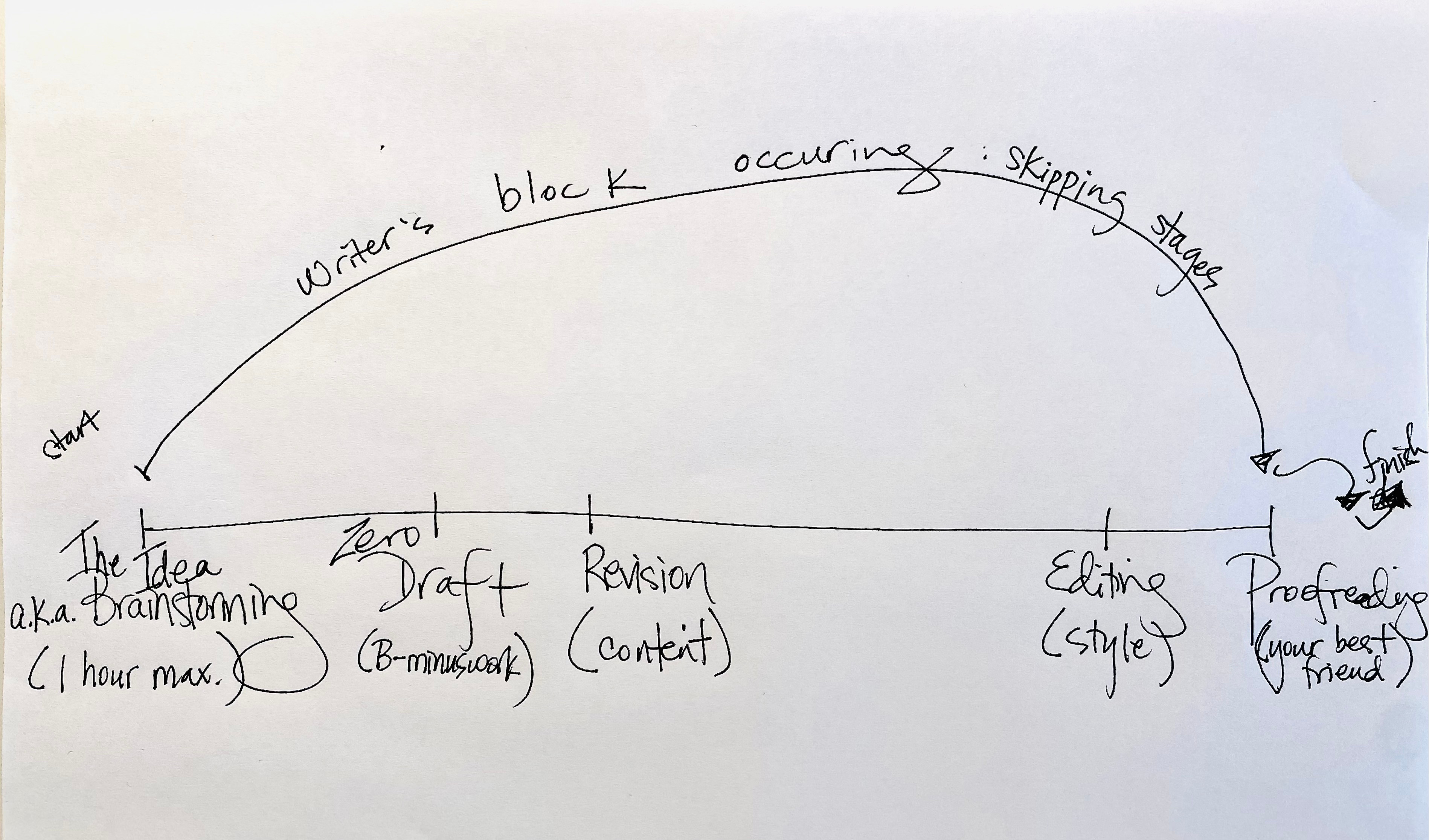
I’ll be taking paid subscribers and Premier members through all five and how knowing and integrating them into your Substack life is essential for growth in 2026.
Because there are also a lot of living Substacks, and whereas a typo or two and a shoddily thrown together post might have been passable a year ago, subscribers and paid subscribers are expecting more.
3 home remedies for Substack writer’s block
Here are my favorite remedies for writer’s block—no workshops or writing coach necessary.
Use your voice
Go for a walk—or sit outside or somewhere away from your computer—and bring your phone.
Use Voice Memos (iPhone) and record yourself talking through the post without looking at notes, nothing. Just ramble. Don’t worry. People will think you’re on your phone. (I do this all the time.)
Revise the transcript and voilá! Post complete.
5-minute timer
You’re just going to write for five minutes. Set an actual timer. You must set the timer. If you don’t, your brain will never believe you. Five minutes. Just five minutes.
Let your post be about whatever is keeping you from posting
When I worked with Tresta Payne, we set up ways to use her Substack posts specifically as a way to write about what she was working on for her book-in-progress, not in a precious way, not sharing a chapter, just sharing what was occupying her time. For you, it might be work, which seems boring but which isn’t because if you’re a good writer (i.e., you don’t use AI and you do rely on your voice and your experiences), you could write about going to buy milk and we’d be riveted.
When Sara Stansberry was ill, I told her to write about exactly that experience—a short post describing the pressure to meet demands and the reality of her situation, rather than forcing the originally planned topic.

I’m going live with Simon Haisell to talk about how Footnotes and Tangents became an iconic top-5 Substack bestseller—today, Tuesday, 1/27 at 2 PM CST. Join us here.
The doors to my 6-week Craft of Writing on Substack course just opened—limited to 25 students. February 20-March 20, Fridays, 12-3. Save your spot and find out more. The last course sold out in 7 days.

SW@W homepage | Premier Membership homepage | Notes Boost Challenge | Chat | Upcoming courses & Intensives | Workshop replay library | Archive

» Thank you for being part of the best community on Substack! Please share Substack Writers at Work and invite others to join us for real, long-term Substack growth.
Love this, Sarah. Thank you for cutting through the noise.
I really appreciated how you framed this. It felt honest rather than prescriptive. I have noticed that when I stop trying to force progress and give myself space to step away, things often start moving again on their own. The challenge for me is trusting that pause instead of panicking that I am falling behind. How do you personally tell the difference between healthy rest and avoidance?